

From pagan ritual to Paris uproar, Stravinsky’s The Rite of Spring rewrote the future of music.
Few works in the history of music have detonated onto the cultural scene with the force of The Rite of Spring. Even more than a century after its infamous 1913 premiere, Igor Stravinsky’s primal masterpiece still feels dangerous.
Its rhythms volatile.
Its harmonies raw.
Its vision of humanity both ancient and unsettlingly modern.
The seed of the work came to Stravinsky in 1910, as he was completing The Firebird. He imagined a stark, almost brutal scene: elders seated in a circle, witnessing a young girl dancing herself to death as a sacrifice to the god of spring.
It was not a polite myth or a romantic ballet.
It was something elemental.
Something ritualistic.
Something real.
Stravinsky shared this vision with two crucial collaborators: Nicholas Roerich, whose deep knowledge of ancient Slavic culture would shape the ballet’s scenario, and Sergei Diaghilev, the visionary behind the Ballets Russes. Together, they set out to create a work that would evoke a distant, pagan past, driven not by narrative elegance but by instinct, ritual, and the overwhelming forces of nature.
But Stravinsky didn’t dive in immediately.
After the exhausting process of bringing The Firebird to life, he paused to compose what he thought would be a small “concert piece.” Instead, that detour became Petrushka, another landmark work.
Only in the summer of 1911 did he return to The Rite of Spring, throwing himself into its creation with relentless intensity.
“What I was trying to convey was the surge of spring — the magnificent upsurge of nature reborn.”
Igor Stravinsky
This was not spring as gentle renewal. It was spring as upheaval.
Ice cracking.
Earth splitting.
Life forcing its way into existence.
Drawing on his memories of Russia, Stravinsky crafted a score that feels more unleashed than composed. The ballet unfolds as a sequence of ancient rituals.
Tribes gather.
Games are played.
A Sage presides.
And then…
in the heart of the work, comes the chilling apex.
The selection of the Chosen One.
A young maiden is marked for sacrifice, and in a final, frenzied dance, she gives her life to ensure the fertility of the land and the survival of her people.
Musically, The Rite of Spring shattered expectations. Its pounding, irregular rhythms seem to lurch forward with unstoppable momentum.
Accents shift unpredictably.
Harmonies clash and grind.
The orchestra becomes percussive, visceral, less a vehicle for melody than a force of nature itself.
At its premiere in Paris, the reaction was explosive. Accounts vary, but what’s certain is that the audience erupted during the performance.
Shouting.
Arguing.
Fighting.
Whether it was the music, the choreography, or the sheer shock of the new, The Rite of Spring provoked one of the most infamous evenings in concert history.
What began in chaos, however, quickly transformed into legacy. The work secured its place as a cornerstone of modern music, influencing generations of composers, choreographers, and artists.
Today, The Rite of Spring remains as electrifying as ever. It speaks to something deeply human.
Our connection to the earth.
Our fascination with ritual.
Our capacity for both creation and destruction.
It reminds us that beauty is not always gentle and that art, at its most powerful, can unsettle as much as it inspires.
Experience it Live
Join the Colorado Symphony for this momentous weekend with conductor Kevin John Edusei — plus electrifying saxophonist Jess Gillam‘s take on Anna Clyne‘s new saxophone concerto, Glasslands, and more!
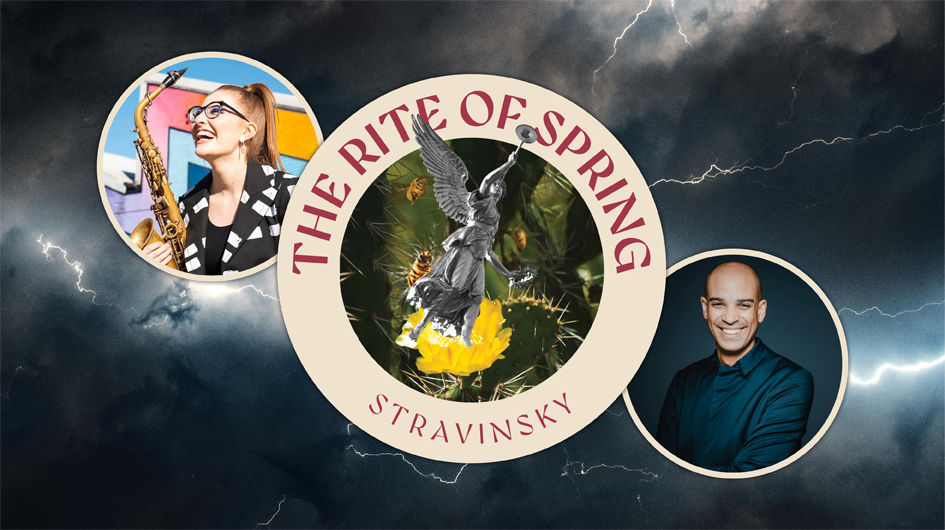
Stravinsky The Rite of Spring with Kevin John Edusei + Jess Gillam
BEETHOVEN Coriolan Overture
ANNA CLYNE Glasslands Saxophone Concerto with Jess Gillam
STRAVINSKY The Rite of Spring