Skip to Content

Colorado Symphony Blog

Why Johannes Moser Still Finds New Meaning in Elgar’s Cello Concerto

November 6, 2026

Why Johannes Moser Still Finds New Meaning in Elgar’s Cello Concerto

Q: When you return to a piece you’ve lived with for years like the Elgar Cello Concerto, does your interpretation continue to evolve?

Johannes Moser: I have two main avenues that keep my repertoire fresh: One is teaching, the other is commissions. Through teaching, I have to verbalize concisely what may only be a faint idea at the back of my mind, and elevating the propositions of my students inevitably leads me to elevate my own views and interpretation. Having Elgar’s circumstances of his life and times as a starting point for understanding the work may be essential, but turning the work into my own and amalgamating it with my own feelings and circumstances is key.

Commissions allow me to get to the heart of a composition: to work directly with the composer and mentally connect their intentions with the written score. This fascinating process can be transferred to composers that are no longer with us: I approach Elgar with the same questions that I would have for, say, Anna Thorvaldsdottir or Detlev Glanert, two of the many composers that have written concerti for me. In the end, that’s what interpretation is about: Finding answers, of course, but more importantly, keeping the questions towards the score real and relevant. Then you have a real chance at a fresh viewpoint at the music, even after 30 years with a piece, like in my case Elgar.

Q: The concerto opens with those unmistakable, almost defiant chords. There’s an extraordinary vulnerability in that opening. What do you want to communicate in those first moments, and how do you establish the emotional world of the piece before the orchestra even enters?

Johannes Moser: For all its extraordinary storytelling, emotional turmoil, and drama, the concerto is framed by something resembling a logical argument. Elgar opens with a thesis — the initial chords — which, after everything we have experienced throughout the work, return at the very end, almost as a musical quod erat demonstrandum: “What I set out to prove has now been demonstrated.” He does so without any triumph, no “gotcha” moment, but rather gives in to his fate.

Q: Elgar wrote this concerto in 1919, in the aftermath of World War I, and during a period of profound personal and artistic disillusionment. The result is a work that feels remarkably intimate, even confessional. When you perform it, how much do you think about the circumstances in which Elgar wrote it?

Johannes Moser: Unless I ultimately make this music my own and connect it to our personal emotional world, it will always feel as though we are experiencing Elgar’s vision solely through his eyes — encountering its emotions vicariously rather than allowing them to emerge from within ourselves. Elgar certainly decried the end of old Europe, the loss of a generation to a senseless war, and his personal ailment. But if we are looking around (or simply browse through our never-ending news feed on our phones) there is a plethora of horrifying things going on in the world right now that connect us directly with Elgars experience and lets us relate our own life and times to this music.

Q: What are you looking forward to exploring musically with music director Peter Oundjian and the Colorado Symphony?

Johannes Moser: Peter and I had the pleasure to perform Shostakovich’s Cello Concerto No. 1 in New Zealand around 8 years ago, a tour that really was most memorable for me. This will be our second encounter, and I am very excited to see him again and to perform this most meaningful music together with the outstanding musicians of the Colorado symphony, many of whom are personal friends of mine. What will we explore? Come and find out!

Experience it Live

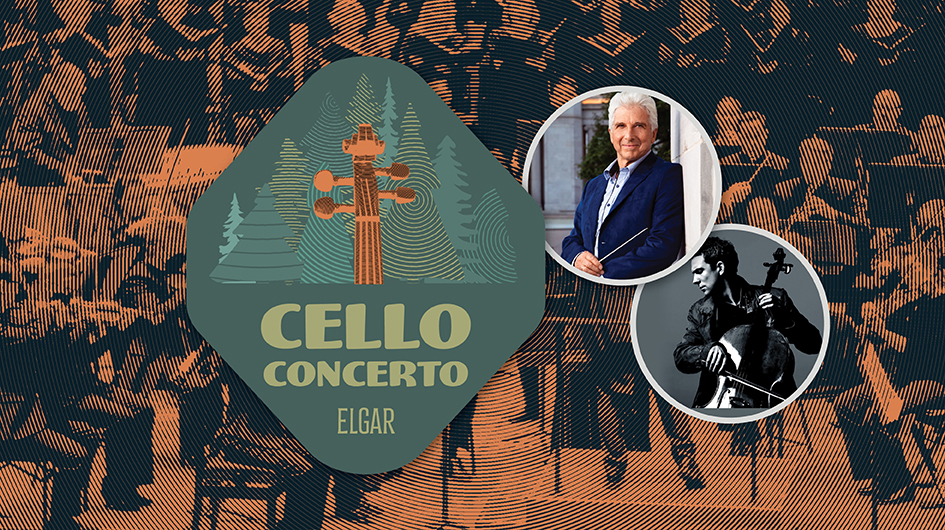
On November 20 – 22 at Boettcher Concert Hall, Music Director Peter Oundjian leads your Colorado Symphony in Elgar’s Cello Concerto – one of the great masterpieces of the early 20th century. In the expressive hands of Johannes Moser, the concerto’s lyricism and emotional vulnerability will resonate with seasoned audiences and newcomers alike.